DarkSide-20k
Currently under construction, DarkSide-20k is the world’s largest direct detection dark matter experiment. It will operate as a dark matter and neutrino observatory at Laboratori Nazionali del Gran Sasso (LNGS) starting in 2028.
Overview
DarkSide-20k
DarkSide-20k, currently under construction at LNGS, searches for dark matter interactions in 50 tonnes of ultra-pure underground argon (UAr) inside a dual-phase Time Projection Chamber (TPC). The TPC is approximately 3.5 m x 3.5 m x 4 m in volume, and surrounded by a 32 tonne single-phase UAr detector serving as the Inner Veto, which itself is enclosed within the Outer Veto—comprising 650 tonnes of single-phase atmospheric liquid argon inside a membrane cryostat with 8 m x 8 m x 8 m internal dimensions. DarkSide-20k’s globally-unique UAr target is extracted at the URANIA plant and purified at the ARIA facility.

Diagram of the DarkSide-20k TPC

The TPC
The TPC is designed to detect interactions of elusive dark matter candidates. The veto systems are designed to reject background events induced by standard particles, which produce scintillation light in at least one veto layer and the TPC—unlike dark matter interactions. The Inner Veto leverages the neutron-capturing power of hydrogen in the acrylic that separates the TPC vessel from the Inner Veto bath. When neutrons interact with the acrylic, they emit gamma rays that shine in both the TPC and the IV, producing a unique coincidence signal that helps distinguish neutrons from WIMPs. The Outer Veto is designed to reject events caused by the small number of muons that penetrate into the underground lab.
Particle interactions in the argon volumes produce charge and scintillation light which are ultimately detected by silicon photomultiplier array detectors, which are then grouped in photon detection units (PDUs). The collaboration completed a multi-year programme to develop this custom photon sensing technology, reaching >3x higher photon detection efficiency, lower noise, and lower radioactivity than the PMTs in the predecessor DarkSide-50 experiment.
Given that we expect only a few dozen dark matter-induced events per year in liquid argon (with the exact number depending on the dark matter mass and its likelihood to interact in the argon), the full suppression and rejection of background events has driven every aspect of the experiment’s design, construction and assembly—from material selection to the development of our PDUs.

Williams undergraduate Rosie Harris working on the DarkSide-20k Mockup

Two REU students, Cassie Geenawalt and Lucy Garn, working at VT on the assembly of the wire-grid test assembly.

One of the eight acrylic barrel panels that make up the vertical walls of the TPC

The vacuum chamber that will be used to evaporatively coat the anode and cathode of the TPC during a final helium leak-check at the fabricator
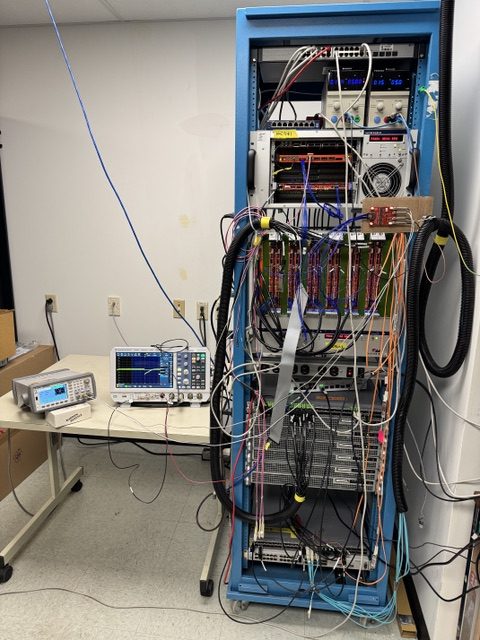
Example of the DarkSide-20k Data Acquisition setup, during the Firmware and Software development at TRIUMF, Canada
DarkSide-20k will search for a wide range of dark matter candidates. The sensitivity to dark matter in the WIMP mass range is shown in Figure 1, based on using both the primary scintillation (S1) and charge (S2) signals. The sensitivity to lower mass dark matter candidates is shown in Figure 2, based on analysis using S2 only (from Phys.Rev.D 113 (2026) 12, 123045). The sensitivity to dark matter that interacts with electron final states is shown in Figure 3 (from Commun.Phys. 7 (2024) 1, 422 ). The sensitivity to supernova neutrinos is shown in Figure 4 (from JCAP 03 (2021) 043).

Fig. 1

Fig. 2: DarkSide-50 (red) exclusion limits with 4 e−e− analysis threshold and DarkSide-20k (teal) expected sensitivity assuming binomial quenching fluctuation model (QF), 10 years exposure, and 2 e−e− threshold. The updated limits are derived using the Lenz-Jensen screening function in the LAr ionization response model and are compared to previous results obtained with the ZBL screening function. Most recent limits from XENONTnT~\cite{XENON:2024hup}, LZ~\cite{LZ:2025igz}, and PandaX-4T~\cite{PandaX:2025rrz} are also presented. The neutrino fog in LAr with index n=2~\cite{OHare:2021utq} is also shown.
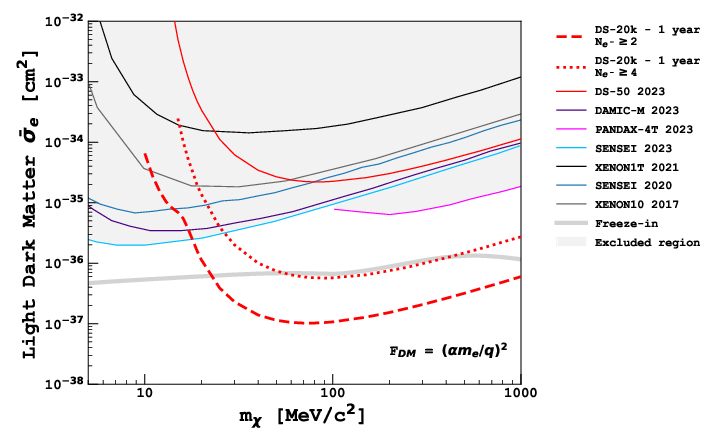
Fig. 3 Neutrino detection efficiency via \CEnNS\ as a function of neutrino energy, for different \nel\ thresholds and below 100~\nel.

Fig. 4 Top. \DSk\ and \Argo\ significance to 11-M⊙⊙ and 27-M⊙⊙ SNe (top) and to its neutronization burst only (bottom), as a function of the distance, assuming the standard background hypothesis (solid line) and (band) lower contamination of 3939Ar up to a factor of 10 less. Vertical lines represent the distance from the Earth of the Milky Way center and farthest edge, and of Large (LMC) and Small (SMC) Magellanic Clouds.

The DarkSide Collaboration aims to unveil the nature of dark matter through liquid argon detector technology and innovative underground experiments. It is located at the Laboratori Nazional del Gran Sasso in L’Aquila, Italy.